







































































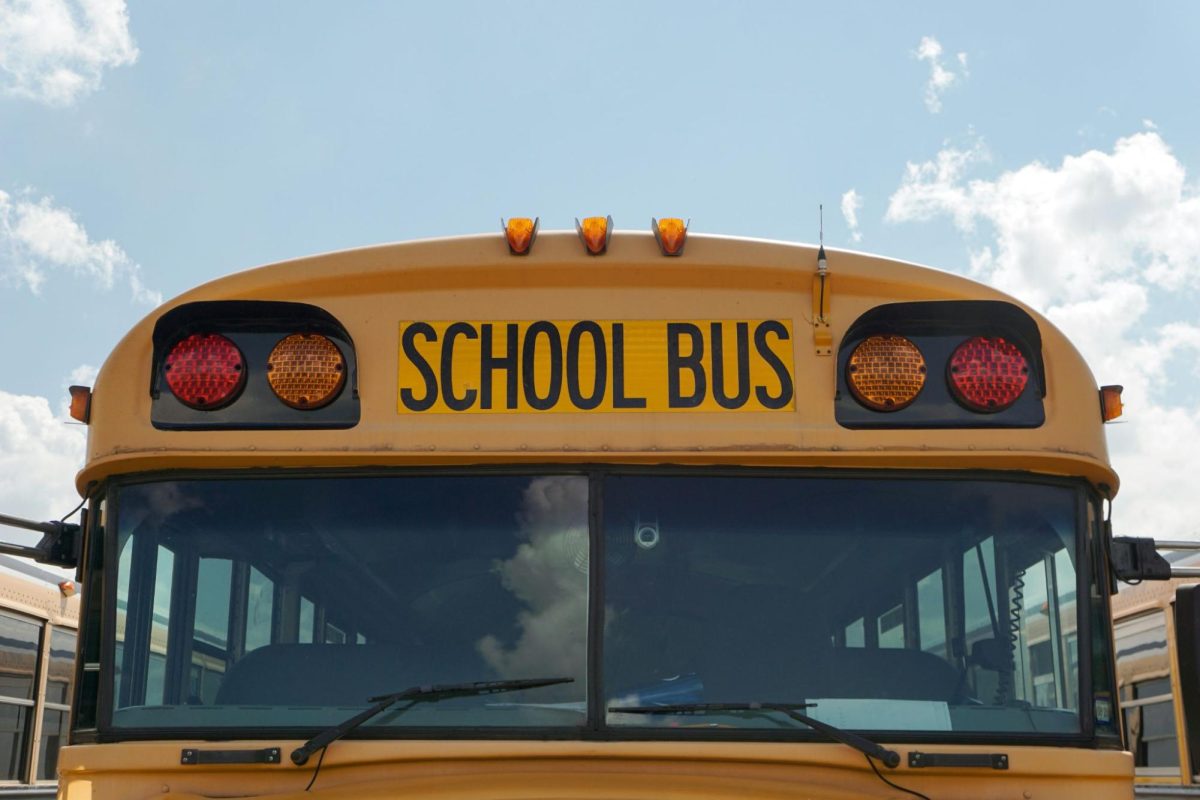
If you ride the school bus, then you know how sharp corners or abrupt stops force you to brace for impact so you don’t slide off the seat. It’s not exactly a pleasant scenario to experience and will ruin the rest of your ride, because you are constantly on guard. In any other vehicle, you are provided seatbelts for this exact situation, but they don’t include them on school buses. Why? And would it be more beneficial to student safety if they were?
The Department of Motor Vehicles answered this exact question, claiming that school buses are built differently from your average bus. School buses are built with student safety in mind, which is why there are so many ways to exit the vehicle in case of emergencies. Manufacturers build school buses with the safety method of compartmentalization in mind.
Compartmentalization, in the words of the DMV, is “closely-spaced seats that have energy-absorbing seat backs”. In the instance that the vehicle gets in a crash, the seats will act as a buffer absorbing the massive shock from impact. Of course, this is a necessary addition for student safety, but what purpose do the seats serve if the students can’t stay in them?
There is a well-kept myth that seatbelts will reduce capacity and make it harder for students to exit the vehicle in case of an emergency. That would, of course, be the case if normal seatbelts were to be implemented, but in this case, manufacturers have thought ahead. Using seatbelts that unbuckle in a single click makes exiting the vehicle not a problem, not to mention seatbelts preventing students from falling out of their seats in the case of a collision.
In the other case, where seatbelts reduce capacity, flexible seating would work around that, fitting three small children or two teenagers to the same seat.. With innovations of capacity and excitement in mind, implementing seatbelt laws on school buses should be seen as a positive, as many of the concerns held don’t necessarily hold water. Seatbelts were invented for human safety and risk prevention.
Seatbelts were invented in 1885 and required to be worn in 1968. Even then, professional car developers knew that seatbelts were a necessary addition. Before seatbelts were made mandatory, the crash rate was significantly higher. A study done by the National Library of Medicine in 1990 randomly sampled a group of 95 car accident cases in the first year and 85 in the second. At the 5% significance level, the study found statistically significant evidence that injuries obtained in car accidents showed a decrease. Even with all the evidence for injury prevention, school bus manufacturers still fail to apply them.
Based on collected evidence, seatbelts would show an increase in student safety, preventing the scenarios of sliding off the seat. In some states, seatbelts are required by legislation for school buses under a 10,000lb weight limit, leaving larger school buses’ requirements up to state decision. In cases where seatbelts were added to school buses, drivers reported that 35% of students were better behaved and 71% have not left their seats while the bus was moving, according to School Transportation News. When you’re not buckled down, it’s hard to stay still, at least that can be observed when watching students as they move from seat to seat while the bus is in motion.
Seatbelts would fix that issue, forcing students to stay where they are and not cause injury to themselves in the case the bus stops abruptly, and they are sent flying. Seatbelts are proven to increase student safety while decreasing distraction for the driver, because if students are constantly moving around, the bus driver could be at risk for distraction and prone to accidents.
The applications of seatbelts are proven to increase student safety and lower the risk of distracted driving. If seatbelts were to be implemented nationwide, it would reduce the risk caused by abrupt stops or sharp turns. For now, a majority of states don’t require seatbelts on school buses, but change is happening, as seen with states like Connecticut. So, it is only a matter of time before more consideration is taken up for belted up buses.