












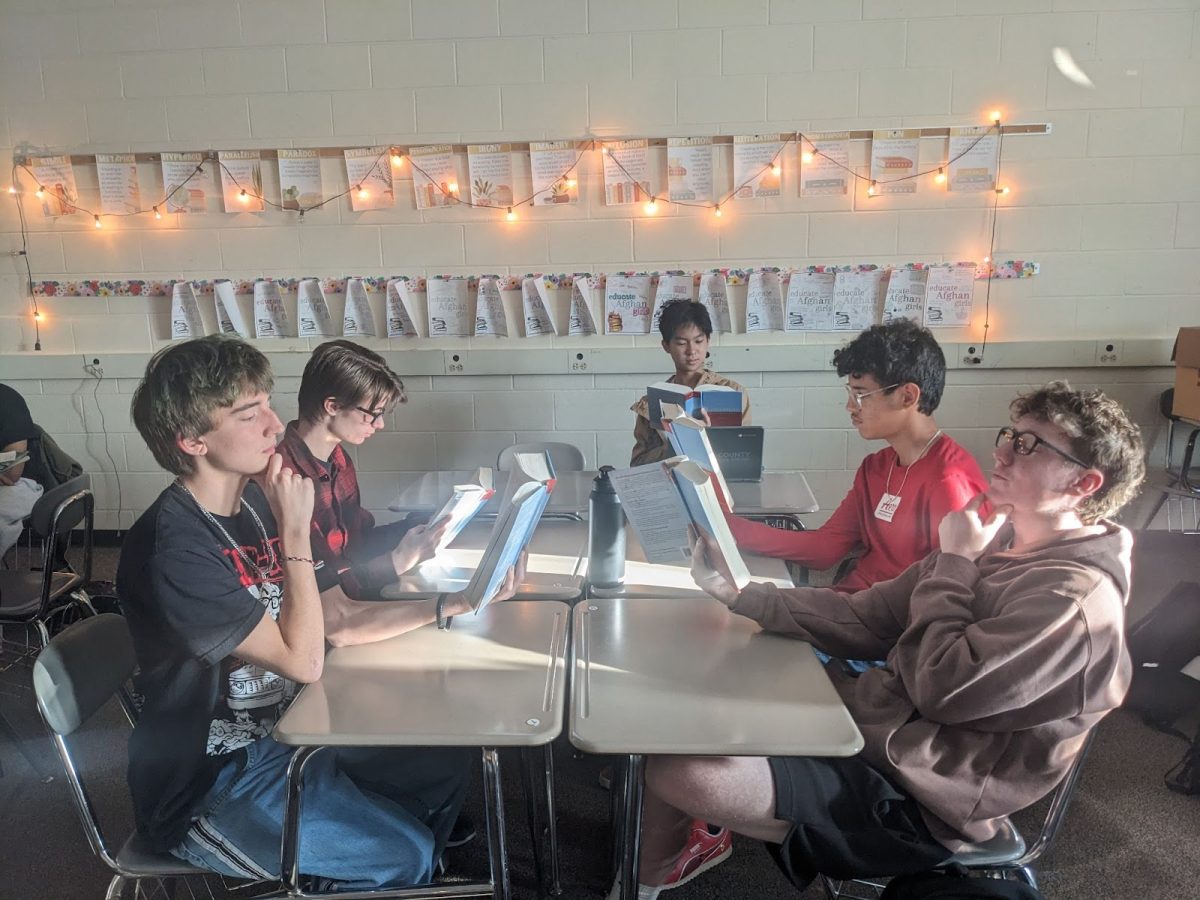















































“She wore a silhouette of clothes that were extraordinary but somewhat gauche.” Do you think that high school students should be able to read this aloud? Most people would likely answer yes. Even though some may not have heard of the word “gauche,” “silhouette” and “extraordinary” are words taught in most elementary schools, if not in middle school.
Yet, in a viral video posted on April 27, numerous high school students struggled with basic words. Most get stumped early on, and one even says “I don’t even know how to read.” This begs the question, why? Why can these high school students not pronounce or even sound out basic words, and what does this say about the modern American education system?
The story starts in the early 1960s with a new and reportedly revolutionary reading strategy by Ken Goodman and Marie Clay. These researchers studied how proficient readers read and attempted to create a curriculum that would allow all students to mirror that. What they noticed was that good readers seemed to use three different cues when reading: graphic, syntactic and semantic cues.
They determined graphic cues to be what the readers see on the page. This could be letters or common stems. Syntactic cues would consist of the part of speech that the word is. For example, this could be a noun, verb or adjective. Lastly, they noticed that good readers seemed to pick up on semantic cues, wondering if the word they are thinking of would make sense in the context. Essentially, there were three questions a skilled reader asked themselves before determining a word and moving on: Does it look right? Does it sound right? Does it make sense?
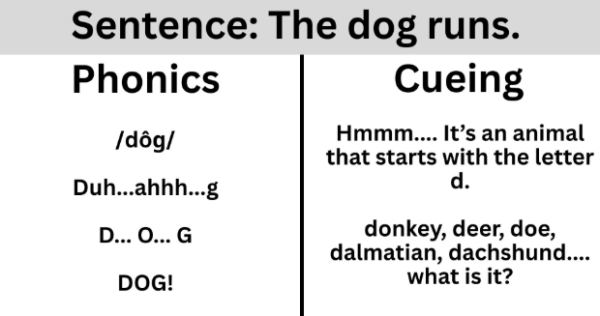
Soon enough, by the late 1980s, the three-cue strategy began dominating the curriculum in schools across the country, replacing the traditional phonics-based curriculum where students were used to sounding out words. Instead, students were taught to guess what word they were reading until they got it right. When students would approach a word they did not know, they would ask themselves the three questions. If their guess lined up, then, according to cueing, they were becoming a skilled reader.
What Goodman and Clay did not realize is that good readers did not necessarily cue at all. Instead, they had a good basis of knowledge on language that they could pull from. What they were doing was not cueing, they just recognized the word that they were reading because they had learned it. Researchers began to realize that the people who were guessing were actually unskilled readers who did not have a good understanding of the language.
Yet, despite study after study disproving cueing, it is still widely implemented in schools today. A 2019 national survey revealed that 75% of K-2 and special education teachers in elementary schools use the three-cue method. It also found that 65% of college of education professors use it to teach incoming teachers how to teach students how to read.
However, it appears that cueing may be losing traction. In 2023, eight states banned the strategy: Florida, Indiana, Ohio, South Carolina, Texas, West Virginia, Wisconsin and North Carolina. While this is a step in the right direction, that is only 16% of states. In the meantime, the average student’s reading level continues to decline.
According to the nation’s report card in reading, students already struggling with reading, in the fiftieth percentile or below, saw significant decreases in their reading scores in the years from 2022 to 2024. This trend is present in both grades four and eight. This means that the students who are struggling to read are getting worse across grade levels.
So, if cueing is declining, then why would the national reading levels not be improving? These trends point to the problem being more deeply rooted than cueing. However, there is likely no singular reason for the literacy crisis in America. School funding varies widely across counties, and student efficacy varies widely on their learning environment. The fact that cueing is only banned in eight states displays how vastly different each state’s school curriculum is and exemplifies the amount of flexibility each state has with that curriculum.
Eventually, the issue becomes a matter of states’ versus federal rights. The tenth amendment of the United States constitution grants the states powers that are not outlined for the federal government. Educational policy would be one of them, meaning that, constitutionally, it truly is up to each state to decide how it will teach its students. Yet, this leads to many regional disparities. The state with the highest literacy rate, New Hampshire, has a reportedly 94.2% literacy rate, while in the lowest state, California, only 76.9% of adults are literate.
While the flaws in each state’s school system may not be resolved at the national level, that does not mean that literacy rates cannot improve. Lobbying a state cueing ban, more funding for reading education or more standardized testing in order to ensure that students can read state by state is necessary for the United States to continue to flourish. Between 46% and 51% of adults below the poverty line are unable to get a stable and well-paying job due to their inability to read. Reading is a necessity in modern society.
Seeing students online that cannot sound out basic words should not be an opportunity to leave a comment criticising the school system and go on with life. Instead, it should be a wake-up call for better legislation to ensure that the students of today can sustain the society of tomorrow, and displays the degree to which the literacy crisis has taken hold of America.