











































































What can impact how high school students perform academically in school? Some may say that lack of sleep, study environment and the usual stress factor affect one’s ability to perform well in schoolwork . However, certain neurological factors that are typically not taken into consideration can cause a severe impact on students.
“ADHD”, also known as Attention-deficit/hyperactivity disorder. is one of the most common neurodevelopmental disorders that affects the brain’s ability to perform executive functions. ADHD is primarily caused by a combination of environmental and genetic factors that range from certain genes to prenatal exposure to toxins. The disorder creates differences in brain structures, such as the prefrontal cortex, basal ganglia and hippocampus, which are often smaller than average and delay maturation. Because these structures control high-level cognitive functions, the differences cause weaker connectivity within brain networks, thus resulting in different activities.
ADHD can be informally classified into three types, where symptoms vary. “Type one” presents as struggles with retaining focus and organization without high levels of activity. People with type one tend to lean more towards inattentiveness, where common tasks like paying attention to details and memory become difficult. “Type two” is considered the “hyperactive” type as fidgeting, restlessness and difficulty with impulse control become prominent. In contrast, people with type two are more hyperactive in cognitive tasks. A combination of both behaviors is known as “Type three” due to both inattentive and hyperactive-impulsive symptoms becoming present. Indicators of ADHD usually set in early childhood, but can also be seen later on in adulthood.
Nonetheless, how does ADHD impact students? Being diagnosed with the disorder, regardless of the type, can make it harder to sustain attention and manage impulses during classes. Having type one makes it substantially harder to efficiently remember lesson details and stay focused during school hours, lowering academic performance. With types two or three, impulses with sitting still, distractions and interruptions also impact the way students behave in class. Students may perform below their potential, needing more time and repetition to learn material.
Further complications like missing assignments and social challenges arise from the impact of undiagnosed ADHD. Often, having ADHD as a teen heightens the usual symptoms due to younger people being more susceptible to emotional and neurological changes. This means that symptoms previously stated are more challenging to manage. In short, ADHD impacts students in a way that causes them to struggle academically eight times more than the average student without the disorder in terms of concentration, content retention and eventual graduation.
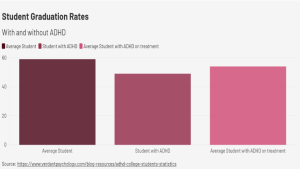
This impact on students can be seen in the graph to the right, where graduation rates in the U.S. are shown between students with ADHD and students without it. The difference in rates showcases how the effects of the disorder aren’t minor, and truly contrast with those of the general population.
To combat the effects of ADHD as a teen, getting the proper help and treatment can significantly increase school performance. By getting help through reaching out to a parent or adult about possible symptoms, achieving an official diagnosis leads to management of the disorder. Therapies and medication such as Adderall or Qelbree and overall support through difficult areas.
Having this disorder changes the way the brain controls complex executive functions, and for students, creating a disconnect in their academic potential. Students everywhere struggle with its impacts, struggles that can be reflected through schoolwork. Getting ADHD managed before its symptoms become adjacent to performance, however, can be critical for minimizing how badly one is impacted by it.