










































































In the early months of 2026, many Americans are being hit with a mysterious respiratory sickness that is attacking their respiratory systems. Side effects of the elusive virus have been identified as fever, congestion and coughing, among other outlier symptoms, as shared by the CDC. The term walking pneumonia has been used more than once to describe the illness affecting over half the American population.
The term walking pneumonia or atypical pneumonia is used to describe a mild form of pneumonia, but still showing all the same side effects. Pneumonia is a lung infection that attacks the air sacs in your lungs forcing them to fill with mucus while trying to fight the infection. This makes you show the predetermined symptoms of whooping coughs that coerces your body to try to expel that excess mucus. Expelling that mucus can cause irritations in the throat which leads to another extension of the virus, sore throat.
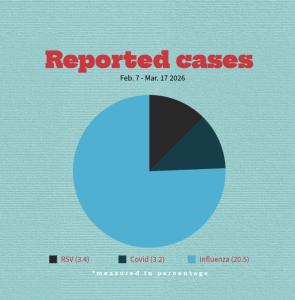
Sore throat is one of the dominant symptoms of the identified virus. It is also a common denominator in RSV, COVID-19 and the flu. These are all viruses circulating the atmosphere, so if you have gotten sick already and are experiencing illness again, it is likely you are infected with another of the three viruses. All of these viruses are similar but do pose some differences.
Respiratory syncytial virus, RSV, usually peaks around the late fall and lasts through the winter months. RSV affects the nose, throat and respiratory tract, according to the CDC. The symptoms are not necessarily specific so it is hard to separate the virus from other common rhinoviruses that attack the nasal passages.
Although RSV is not typically deadly, it is still possible for death to occur if the symptoms are severe enough. The virus usually holds a death count in the 100,000’s in children under 5 years, and among the elderly, according to the World Health Organization. If individuals are not in these ranges, then the virus isn’t as concerning to them, as long as proper precautions are taken. Unlike RSV, the flu can be more stressful on the immune system.
The flu is a more common respiratory virus that appears in the late fall and early winter, with cases lasting until spring. Because the flu is a virus that the world has dealt with for several decades now, vaccinations and treatment aren’t hard to find. Over-the-counter medications such as Ibuprofen or DayQuil are reported to treat most symptoms associated with influenza. Normally, hospital visits aren’t mandatory if an individual is infected with the flu.
Hospitalizations regarding flu type A cases have generally been decreasing over the last decade, while type B varies depending on the region, according to the CDC. Although medications are adapting to the flu, it still holds the majority in terms of registered cases. COVID-19, on the other hand, has begun to decrease after the worldwide pandemic a few years ago.
As many people may remember, the world was under lockdown due to a life-threatening virus, Coronavirus disease 2019. During that time, civilians were forced to stay in their homes and expected to wear a mask when exiting said homes.
Once schools and jobs reopened, everyone was mandated to wear their masks and sanitize frequently. Cleanliness became the new norm, and infection rates of communicable diseases and viruses dropped rapidly. The world saw its lowest infection rates for the first time in recent history.
Today, COVID-19 is looked on as nothing more than a mild cold that can be treated with over-the-counter medicine. COVID shows many of the same symptoms as RSV and influenza, such as a fever, body aches or cough. Still, if symptoms are serious enough, and if infected individuals are a young child or elderly adult, a hospital visit may be necessary.