




















































Green Hope offers 26 APs, a wide selection that allows students to explore potential career paths, save time and money in college and help their resumes stand out. However, there can be a lot of uncertainty around which courses to take. This article will cover six of the most popular AP courses that Falcon underclassmen choose to take.
AP World History
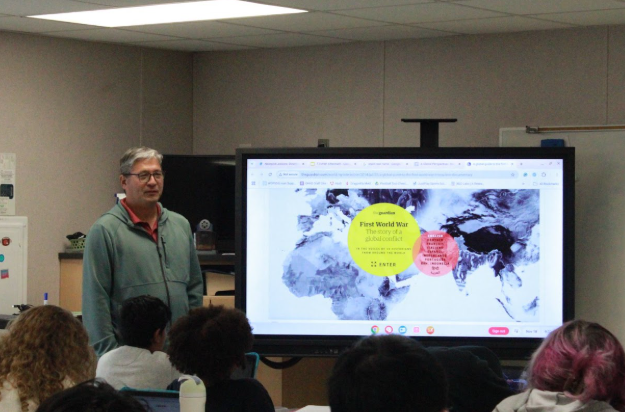
AP World History is a fast-paced and compact course, often the very first AP class that freshmen take. It covers detailed content from diverse cultures across a wide time frame, combining many years of history content into one class. To study effectively in this course, it is important for students to identify broader trends and historical themes that the course seeks to instill. Many students swear by Youtube channels like Heimler’s History, which is run by a former high school history teacher. His channel can be a helpful resource for reviewing before tests and tends to guide students towards the important course themes. Reading ahead or previewing the AMSCO textbook before starting the course can also be a great way for students to allow themselves more time to digest the material. For AP World History, students should expect to spend time outside of class each day reading a section of their textbook, as the focus in class will be to discuss concepts that were read while completing other assignments.
Students are exposed to multiple choice questions that require them to think critically to apply historical knowledge, as well as free response questions where they must build and support historical arguments in a highly formulaic manner. If this is the first AP class a student takes, it can be valuable in getting familiarized with the structure and workload of subsequent AP classes.
AP US Government and Politics
Out of the history and social sciences AP’s offered at Green Hope, AP US Government and Politics has the highest percentage of students receiving a score of five on the AP exams. Primarily sophomores take the course, with some students that took the honors course for World History in ninth grade choosing to move up to AP for Government. The structure of the free response questions are somewhat different from the structure in AP World History / AP US History / AP European History, with a focus on foundational principles of government, political processes, the evolution of public policy through Supreme Court decisions and methods of political analysis. In total, students will be required to memorize nine foundation documents from the history of the United States, 15 core Supreme Court cases, key constitutional amendments and vocabulary relating to political processes.
AP US History
AP US History is a course taken primarily by juniors that fulfills the Wake county graduation requirement for American History. It is a highly intensive course by almost all accounts, but in the words of Mr. Hutchison, an AP US History and American Indian Studies teacher at Green Hope, “There’s a benefit to taking the AP version that makes the workload worthwhile, for a student that is willing to take it on.” Unlike the honors or academic analogs, “it’s that focus on history as a verb- as an activity as opposed to just sort of collecting historical knowledge. We’re more concerned with what you do with it, how you interpret it and use it to build historical arguments.”
He says that in order to do this, students need to do a considerable amount of work outside of the classroom. They can expect to read around two to three chapters of the textbook each week, and especially for spring semester students, who have a shorter amount of time than the fall semester due to the AP exams, the work can get intense. “But we don’t ever lecture back through that content,” says Mr. Hutchison, “The expectation is that you come to class with a general picture in your head of the major events and timeline of the chapter so that we can dive into certain events in more depth in class.”
On the scores students typically receive in the class, Mr. Hutchison reflected on his previous semester’s student grades. The overall average was an 87, and a significant number were A’s, with a few B’s and C’s. He says that it is rare that students make lower than these scores, and it is usually because of students being absent for a large portion of the class or just trying to scrape through, without having an actual interest in the course.
AP Precalculus
For students successful in Math 3 or 4, AP Precalculus may be a great next step to get a feel for higher-level mathematics. With a large focus on modeling and functions, it also covers algebra, trigonometry and simple proofs. It introduces the concept of limits using algebraic and graphical representations and serves as preparation for the AP Calculus course.
The 2025 AP score distribution page on Collegeboard for AP Precalculus showed 28.1% of national test takers earned a scale score of five, with 80.8% of all test takers earning a three or above.
AP classroom, which students can access once they are enrolled in their AP Precalculus course, is a helpful resource that provides video lessons explaining course concepts, as well as practice with AP style questions that teachers can assign.
AP Physics 1
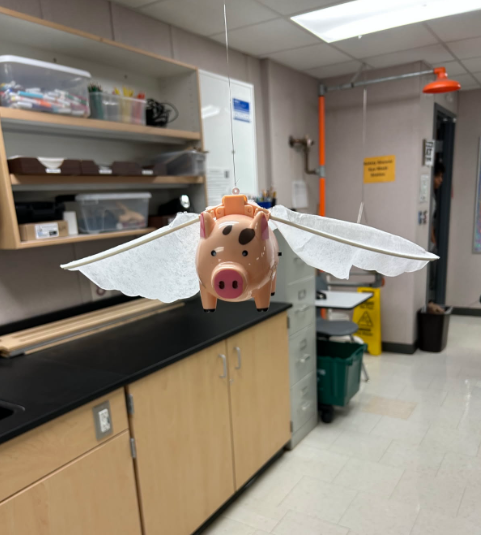
AP Physics 1 is an algebra-based introductory physics course taken by many sophomores, juniors, and seniors at Green Hope. It is recommended that students will have completed Math 3 as a prerequisite for the course, or are enrolled in the course at the same time. The course is heavy on math, as the calculations and laboratory work revolve almost entirely around it. Trigonometry in particular is an important concept from earlier coursework that is used throughout the Physics 1 course to analyze motion and force in multiple dimensions. The labs in Physics involve collecting data (time, distance, etc.), making calculations, mapping motion, and determining sources of error.
In terms of the score distributions of students that take the course, Mr. Coffrin, an AP Physics 1 teacher at Green Hope, shared that out of his previous semester’s class, 35% received A’s, 40% B’s, 6% C’s and 19% D’s for their final grades.
AP Psychology
AP Psychology is a popular AP taken at Green Hope, chosen mainly by sophomores along with some juniors and seniors. The Psychology course emphasizes analysis of research methods. Students examine studies to determine “the type of research method being used – like an experiment or correlational study – and talk about the variables, the generalizability and the ethics, and make a conclusion of whether or not the researcher’s hypothesis was supported.”
Ms. Pyland stated that students can expect anywhere around five to seven pages of textbook reading per night, with students successful in the class spending roughly 30 minutes daily for psychology. Her number one request for students that are considering taking AP Psychology is to consider whether they have a genuine interest in the subject. “I think because it’s so content-heavy, if you’re not interested in the content, it makes the class much more difficult.”
When asked if there were any particular courses that were most helpful in preparing her for AP Psychology, Cora Vogel (‘28), a 10th grade student at Green Hope, stated, “I would say that the AP class I took previously – World History – helped me prepare for the workload of the class.”
Unique to the class are two major projects at the end of each quarter. In the first quarter of class, students have a group panel discussion, choosing a topic as a group and studying individual psychological studies to present to the class. Then, in the second quarter, students conduct an independent research project that culminates in a 10 to 12 minute presentation and a 10 to 12 page research paper. Ms. Pyland says that her students tend to really enjoy their final projects because it provides an opportunity for them to dig deeper into a topic they’re interested in.
In her previous semester’s classes, Ms. Pyland had 40% of students earn an A, 40% earn a B, 9% Cs, and the rest D’s, with no students receiving a failing grade.
Final Notes
Taking AP Courses can have a lot of benefits, preparing students for college and higher-level education, getting them started on potential career paths, and helping boost their resumes. While colleges may not always accept completion of these courses, they are valuable opportunities that should be considered.
As students start to register for their next classes, they can expect to see their teacher’s recommendations for courses. Generally, a grade of A or B in an honors or AP course is the benchmark for recommendation to the next AP course. However, if students have any questions about a teacher’s recommendation for them, it’s best advised that they talk to their teacher- a lot depends on what the student wants to focus on, and the time they’re able to spend working on a class. If they were to simply sign up for the next AP course in their paths without planning out their choices, they may find that it’s more work than anticipated.
The GHHS Course Registration guide and information under Student Services -> Course Registration on the school website will be updated with dates and helpful information with regards to signing up for classes.