













The first Thanksgiving was held in the fall of 1621, with the Pilgrims having a celebration after their first successful harvest with the help of the Wampanoag tribe. The feast took place in Plymouth with the Pilgrims and Wampanoags celebrating together, and signified a turning point for the Pilgrims.
It all started when the English colonists aboard the Mayflower landed in Patuxet in the fall of 1620. Patuxet was a once thriving village that was devastated by diseases brought by prior European colonists. The people sailing on the Mayflower had different motivations for coming to the Americas, such as religious freedom, starting a new life and bringing new profitable goods back to Europe. After they decided to settle in Patuxet, they renamed it Plymouth after their departure point in Plymouth, England. During their first winter in the Americas, around half of the colonists died due to lack of experience living in the new lands.
After the Pilgrims’ first winter, the Wampanoag leader, Ousamequin, arranged a meeting with the Plymouth Colony governor, John Carver. There, they formed an alliance between the two sides, where they would come to each other’s aid if they were to be in a conflict with another party. The Wampanoag were motivated to form the alliance because the colonists’ firearms could provide valuable protection if they were ever attacked by other tribes, and the Pilgrims knew that making good relations with the Wampanoag would be crucial for their survival in the new colony.
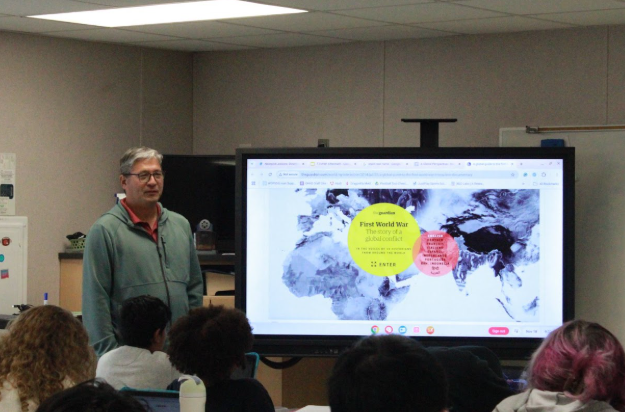
Once the alliance was established, the Wampanoag people started trading local indigenous seeds such as corn, beans, squash and pumpkins which were able to grow in the American soil. They also started to teach the Pilgrims how to farm effectively and what foods to forage and hunt in the area. With the help of the Wampanoag, the Pilgrims were able to grow their first successful harvest. In the fall of 1621, the Pilgrims feasted, socialized and hunted for animals. Mr. Hutchison, the AP US History teacher at Green Hope, added, “The Wampanoag heard the gunfire, so their leader and around 90 soldiers came rushing to Plymouth because they thought Plymouth was under attack.” The Wampanoag joined the feast and together, they had what is known as the first Thanksgiving.
In the following years, the Europeans continued to take over much of the natives’ land, and natives were soon being controlled by colonization. In 1675, Ousamequin’s younger son and leader of the Pokanoket subtribe, Pometacom, brought together warriors from all tribes to resist the English colonists and save their homelands. The war ended in Pometacom’s death in 1676. By 1700, the English controlled most of the region on the eastern seaboard of what is now the United States. They soon overpowered the natives and forced them to give up land and become enslaved and indentured to the English settlers.
Around 200 years later, Americans held a popular tradition of having a big celebration at the time of harvests and called them thanksgivings. They gathered with their families and had feasts from harvests, but never really had a specific date. Alexander Young, who was a writer at the time, wrote a book about the Pilgrims and the Plymouth Colony. In the book, he wrote about the feast, which was very unknown at the time, and assumed it was a thanksgiving and added a footnote saying that it was the “first Thanksgiving”. When the book was published, the feast’s term of the “first Thanksgiving” was transferred to many other books and stories.
This was later rediscovered by Sarah Josepha Hale, the editor running the Godey’s Lady’s Book magazine. GLB was very popular at the time and had already influenced many Americans to celebrate thanksgiving and many of its traditional meals that are eaten today. Once Hale discovered the “first Thanksgiving”, she encouraged many people to celebrate Thanksgiving to honor the feast between the Pilgrims and the Wampanoag. The feast of 1621 became very popular, and more and more Americans started to celebrate the holiday.
Hale started to write to government officials such as presidents and Congress members, but no one listened. By 1861, the US Civil War broke out between the states, but many people continued to celebrate Thanksgiving. So when William Seward, the secretary of state for President Lincoln, got a message from Hale in 1863, President Lincoln saw it as a way to unite the country. On Oct. 3 of 1863, President Lincoln declared Thanksgiving a national holiday that would be held on the fourth Thursday of each November.
Thanksgiving has changed a lot from what was called the first Thanksgiving, which actually wasn’t even a true thanksgiving. Mr. Hutchison revealed, “They would not have called it a thanksgiving because people were celebrating the harvest, and since the harvest was their first successful harvest, the governor declared a feast.” The closest thing that the English colonists had to a thanksgiving were days when they would spend the entire day in prayer to honor their relationship with God, and they would actually fast for the entire day, the opposite of what Thanksgiving is today.
Today, Thanksgiving is a holiday where people celebrate the things they have, and show appreciation for what they are thankful for. “Contrary to its original purpose of being patriotic, it has become more personal over time, which I think has made it more meaningful,” said Mr. Hutchison. A host to a friendsgiving party, Amy Frisz-Conlon, also added, “I think it’s a great opportunity for both friends and family to get together and remember and appreciate each other.”
Thanksgiving has come a long way from its origins in 1621, evolving from a harvest feast with the Pilgrims and Wampanoag to a national holiday to gather with family and celebrate with feasts and traditions. The significance of Thanksgiving today for showing gratitude isn’t the same as the reasons for the celebrations before, but knowing the history behind the holiday gives a deeper appreciation for the challenges people went through and where people are now.