






































































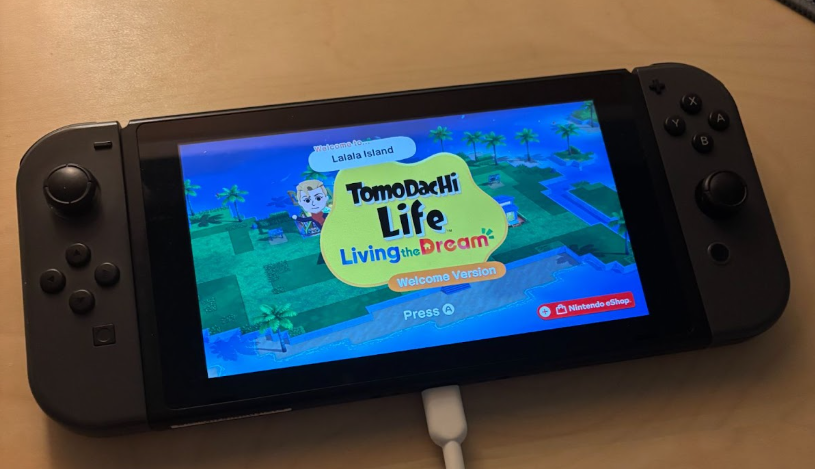
Have you ever wanted your own little society where you can play God? The new game Tomodachi Life: Living the Dream nearly gives you that ability. Tomodachi Life: Living the Dream is like an unhinged version of The Sims mixed with Animal Crossing, allowing players to control various “Miis” — or little people inhabiting the island — they put on their island by feeding, clothing, housing and developing relationships for them. As the island progresses, Miis can create families and develop complex storylines for the player to watch, the only limit is the player’s creativity.
The first Tomodachi Life came out on Nintendo 3DS on June 6, 2014. The game was unique for the control that the player had. The island’s path was truly up to their discretion in comparison to other popular Nintendo games, such as Mario, where the player went through prescribed levels in order to progress. Tomodachi Life had no true or intended progression, and that was part of what made players love it.
When the Nintendo 3DS stopped being released, the game became a past gem that people still enjoyed, but it became significantly more difficult for new players to try. That remained the case until Nintendo announced Tomodachi Life: Living the Dream, a sequel to the original game that would come over ten years after the initial game’s release on April 16, 2026. The game is available on the first Nintendo Switch generation, but can also be played on the newer Nintendo Switch second generation.
The game would remain largely unchanged with the ability to create Miis on an island, but the new game contained many new features, particularly relating to customization. Players could now customize their Mii’s makeup during customization, use more advanced hair creation, customize eye and pupil shape and even add ears to their Mii. After the Mii is created, players are tasked with creating its personality by ranking attributes such as speed of movement, honesty of speech, energy, if their attitude is chill or serious or if they are normal or quirky overall.
Click below to learn about the different personality types. See which one is most similar to you!
https://public.flourish.studio/visualisation/28665880/
Caption: The sixteen personality types in the game are divided into four main categories: considerate, reserved, ambitious and outgoing. Each personality impacts how Miis will act on the island and makes Miis more unique.
Once players add Miis to an island, they can progress by leveling up the Mii’s happiness. This is done by giving Miis items like food or gifts. In the sequel, players can create their own items to give to the Miis, which adds a personal touch to the game. A unique aspect to giving items to Miis is that the Miis form opinions on the items. If they are given food, they tell the player whether or not they like it for the future. This small aspect gives the Miis more personality and nuance.
Players essentially watch their Miis grow up and meet each other. As they develop their relationship from stranger to friend to lover, they can even have children. Eventually, entire family trees can play out on the island full of any pairing the player could imagine — although Miis will bar you from creating romantic relationships that contain sibling Miis. Miis typically decide whether to accept or reject proposals of love or friendship. Additionally, Miis walk around the island on their own and can develop relationships while the player is off-line, making the island nearly autonomous.
So where does the player come in if the Miis are self-sufficient? Even though Miis can talk with each other without interference, the player can shape their interactions in a variety of ways. Miis frequently ask the player for advice before approaching another Mii, this lets the player have a degree of control over relationships or conversation topics. When Miis ask for conversation topics, the player can give them anything to talk about and let the conversation play out. If the player wants two Miis to meet up, they can “pick up” the Miis and transport them to one another in a more artificial encounter.
In the first Tomodachi life, same-sex marriages were not available in-game, much to players’ dismay. The Japanese version of the game came out first and contained a glitch that allowed players to switch their Mii’s gender to female, which players utilized to create same-sex relationships. When the game came out through Nintendo in English, this glitch was eradicated and fans were angry. Nintendo issued an apology, and in the new Tomodachi Life, same-sex relationships are now an option. When creating Miis, players are prompted, asking about gender — female, male or non-binary — and relationship preferences with an option to select preferences for gender and the ability to select multiple genders to be attracted to.
Tomodachi Life: Living the Dream is a new chapter of an old fan-favorite game. Whether players want to simulate real-life, a television show or create their own fantasy world, the game offers fun storylines and opportunities for creativity around every corner.