






























































The Winter Olympics have just drawn to a close, and while this year had its usual fair share of heartwarming stories of victory, many teams and athletes got sent home from heartbreaking disqualifications and injuries. This year’s Olympics were riddled with controversies and cheating scandals, questioning the integrity of many competitors.
Norwegian biathlete confesses to infidelity:
With 41 total medals and a whopping 18 golds, the Norwegian Olympic team made headlines in more ways than one. Their dominance in the distance skiing events was apparent. One of such skiers, Sturla Holm Lægreid, contributed three silver medals and two bronze, but made headlines for other reasons. Following his first bronze medal of the competition in the 20km biathlon, Lægreid confessed to cheating on his girlfriend live on international television. In a grand spectacle of a humiliation ritual, Lægreid broke down in tears on the world’s biggest stage. “Half a year ago, I met the love of my life. The world’s most beautiful and nicest person. Three months ago, I made the mistake of my life and cheated on her, and I told her about that a week ago,” he said.
Despite “having the gold medal in life,” the Norwegian was crippled by his emotions. Whether this be indicative of the mental pressure that Olympic athletes face, or an obscure personality kink, Lægreid certainly made headlines this year.
Lindsey Vonn crashes once again:
After a dangerous crash, renowned Alpine Skier Lindsey Vonn has returned to the United States and undergone surgery. Vonn experienced the crash in the Olympic Women’s Downhill after clipping one of the gates with her right arm, taking a tumble and being airlifted off the mountains. Vonn experienced what is known as a complex tibia fracture, classified as a severe injury when the shinbone breaks into multiple pieces.
This injury comes just after a ruptured left ACL that the American Skier experienced just nine days before. However, Vonn chose to still compete in the Olympics to pursue her own goals. Some view this as the ultimate athlete mentality, stopping at nothing to achieve goals. Others may call the action selfish; however, as someone else could’ve taken Vonn’s place in the Olympics.
In a social media post from a hospital in Italy, Lindsey Vonn stated, “My ACL and past injuries had nothing to do with my crash whatsoever,” and continued to talk about her achievement of competing, “I hope if you take anything from my journey, it’s that you have all the courage to dare greatly. Life is too short not to take chances on yourself. Because the only failure in life is not trying.”
While Lindsey Vonn’s crash is heartbreaking to her supporters, she wishes people not to feel sad for her. She got a chance to compete in one of the world’s greatest competitions and had the potential to win it all.
Ilia Malinin lands the first legal backflip in 50 years:
The “quad god” was undoubtedly the face of US figure skating this year. Many fans who had hardly ever watched the sport tuned in to see Malinin’s electric style on the ice. As opposed to making headlines for his signature quad axel (which earned him the nickname), Malinin was put in the spotlight for his stunning, yet controversial, backflip. Not only was it a feat in and of itself, but Malinin performed the move in his first two programs on Olympic ice, sending the arena into a frenzy. The last person to land the trick in competition was Terry Kubicka, also an American, in the 1976 Olympics. Immediately after its introduction, the backflip was banned in the following year due to its considerable risk. While many other skaters continued to perform the trick in other showings, the backflip remained dormant in the Olympic scene until French skater Surya Bonaly performed the trick, despite its illegality, at the 1998 Nagano Games. In a run that was already deemed out of podium contention, Bonaly’s flip was widely seen as an act of defiance. Though the move can no longer lose a skater points or add to their technical score, Malinin’s reintroduction of the move opens the world of figure skating to a wealth of future possibilities.
Canadian curling scandal:
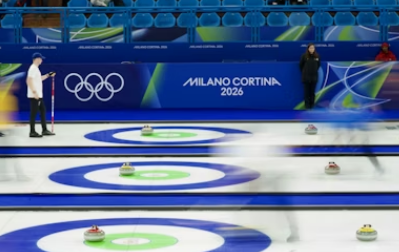
In the Olympics, a standard of professionalism in sports is expected, but a scandal occurred during the men’s curling round robin, when Canada faced Sweden. The sport of curling, where stones are slid across the ice, has been shaken by cheating allegations.
The claim from Sweden was that Canadian athlete Marc Kennedy “double-touched” the stone. In curling, there is a hog line, which is the line by which the player must release the stone before letting it cross. Once the stone is released, it is considered illegal to touch it. Kennedy, however, reportedly touched the stone past the hog line, causing a double touch. In a video of the match, the Olympic curler is seen releasing the stone and then giving it a slight push with his finger.
Tempers flared as the Swedish athletes went to ask if the touch was allowed. When Swedish Curler Oskar Eriksson said, “Apparently it’s okay touching the rock after the hog line, I don’t know.” to Marc Kennedy, who replied, “I haven’t done it once, you can f— off.” After the referees weighed in to officially state that no cheating occurred, some interesting conversations will surely come up in the sport of curling, especially in future winter Olympics.
Inflated Genitalia:
In a game of inches, every competitive advantage matters. At Milan-Cortina, the ski jump events were under the spotlight for something other than their high-flying stunts. Allegedly, this year’s jumpers were investigated for inflating their genitals in order to gain a couple of extra inches in a loose-fitting suit. For casual viewers, this scandal raised many questions, mainly, why would someone do such a thing? The additional surface area created when the suits are tailored generates enough lift to the point where a single centimeter of extra material at the crotch could increase jump length by as much as four meters. Whether or not these altered suits actually made an appearance on the slopes this year is unclear, but the allegations certainly fueled public attention.
Ukrainian skeleton racer disqualified:
Skeleton racer Vladyslav Heraskevych was disqualified from the competition. The Ukrainian athlete was sporting a helmet that depicted over 20 athletes killed during the war in Ukraine. Heraskevych was aware that his helmet was against the rules prior to the race and was told to take it off, but refused on multiple occasions. His disqualification comes on the grounds of rule 50 of the Olympic Charter, which states that “No kind of demonstration or political, religious or racial propaganda is permitted in any Olympic sites, venues or other areas.” Rule 50 enforces the importance that the International Olympic Committee (IOC) places on neutrality in the games. While the Committee allows for some speech outside of races and in press meetings, it prohibits certain expressions in competitions. The IOC and Heraskevych attempted to come to a compromise, such as allowing the racer to show his helmet outside of the race. However, Heraskevych refused to compromise still and would not remove his helmet for the competition, causing the IOC to disqualify him in a tough decision.
In an interview with AP News, Heraskevych stated his opinions. “I would say it’s painful that it really looks like discrimination, because many athletes were already expressing themselves […] They didn’t face the same things […] Just the Ukrainian athlete in this Olympic Games will be disqualified for the helmet.” Heraskevych seems to think the disqualification was based more in discrimination rather than following the rules.
Ukrainian President Volodymyr Zelenskyy chimed in on Instagram, posting, “Sport does not mean oblivion, and the Olympic movement should help stop wars, not play along with the aggressor.” Taking a shot at Russia, he said, “It is Russia that constantly violates the Olympic principles and uses the time of the Olympics for war […] in 2026, despite numerous calls for cease fire for the duration of the winter Olympic Games – complete contempt on the part of Russia and an increase in missile and drone strikes on our energy and our people.”
Continuing his frustration, he even called out the Russian athletes, “13 Russians are now in Italy and are participating in the Olympics. At the Olympic Games, they are under ‘neutral’ flags, and in real life they publicly support Russian aggression against Ukraine […] They deserve to be disqualified.” Zelenskyy concludes with, “We are proud of Vladislav and his deed. Having courage is more than having medals.” Heraskevych’s controversial disqualification may haunt Ukrainian Olympic Teams for future years to come.